

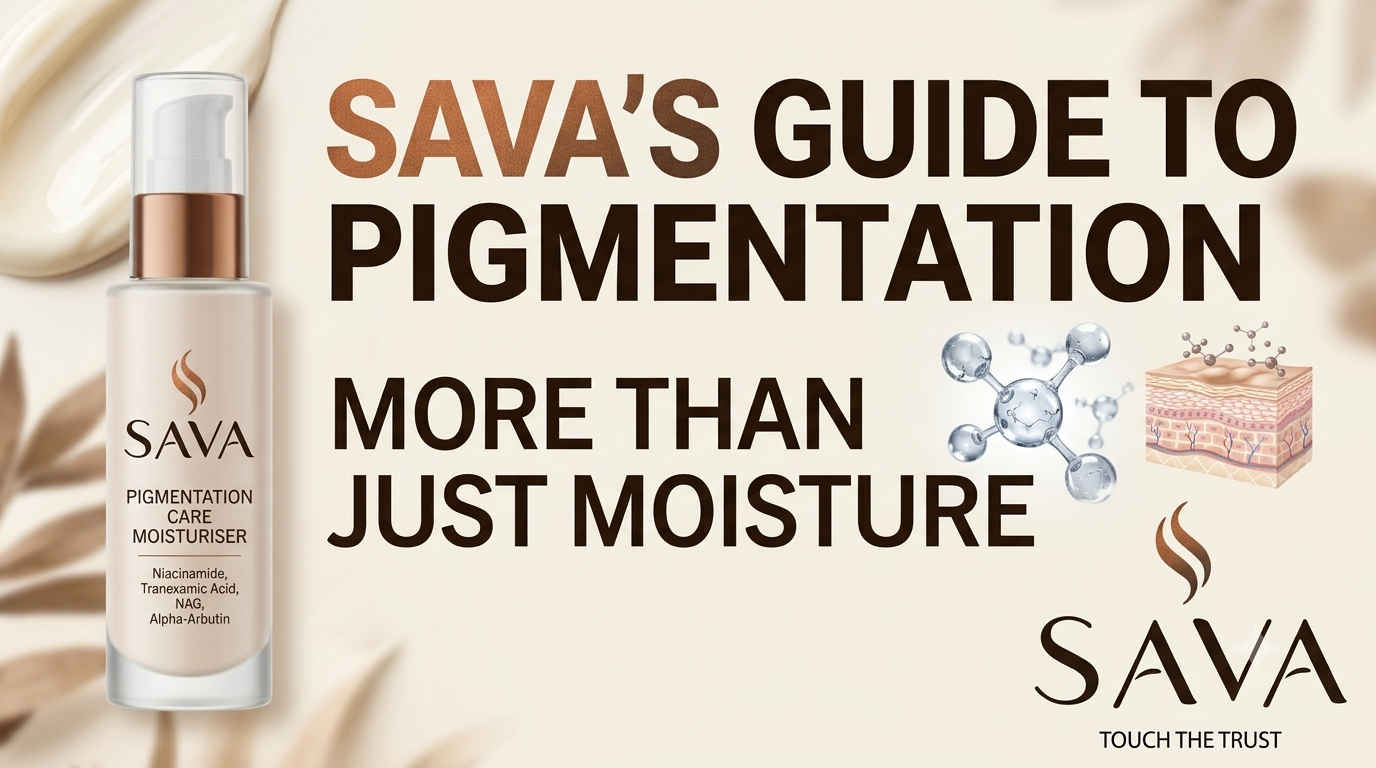
Understanding pigmentation, hydration and the science behind a healthier-looking skin barrier.
Have you ever noticed that your skin looks dull even after applying moisturiser? Or that those stubborn dark spots seem to stay longer than your latest relationship?
Well, your skin might be telling you something.
Sometimes, the problem isn’t simply a lack of moisture. It could be a combination of uneven pigmentation, dehydration, a weakened skin barrier and environmental exposure.
And that’s where understanding your moisturiser becomes important.
First, let’s talk about pigmentation.
Imagine your skin has its own little colour-management department.
Its job is to produce melanin, the natural pigment responsible for your skin colour. Melanin is also part of your skin’s defence mechanism against environmental stress, particularly UV exposure.
But sometimes, this process becomes uneven.
You might notice:
* Dark spots left behind after acne.
* Uneven patches around your cheeks or forehead.
* Tanning after spending time outdoors.
* Persistent dark marks that seem difficult to fade.
* A complexion that looks less even than before.
This is what we commonly refer to as hyperpigmentation.
And here’s something important: pigmentation isn’t always caused by the same thing. Sun exposure, inflammation, hormonal factors and certain skin conditions can all play a role.
So, using a random brightening cream and expecting overnight results? That’s not exactly a skincare strategy.
Plot twist: Your moisturiser can do more than you think.
Most people divide skincare into three categories:
Face wash removes dirt.
Serum targets specific concerns.
Moisturiser simply provides hydration.
But the third category deserves a little more credit.
A well-formulated moisturiser can support the skin barrier, reduce moisture loss and deliver ingredients that complement a pigmentation-focused routine.
Think of your skin barrier as the security system of your house.
When it’s functioning properly, it helps keep essential moisture in and unwanted irritants out.
When it’s compromised, your skin may become dry, sensitive, uncomfortable and more prone to irritation.
And irritation can sometimes contribute to post-inflammatory pigmentation.
This is why hydration and barrier care shouldn’t be treated as optional extras in a pigmentation-focused routine.
Let’s decode the ingredients. No complicated chemistry class, promise!
1. Niacinamide – The multitasker
Think of Niacinamide as that one employee who handles three departments without complaining.
It’s a form of Vitamin B3 and has multiple skincare benefits.
It supports the skin barrier, helps improve moisture retention and can reduce the appearance of uneven pigmentation by influencing the transfer of melanosomes (the structures carrying melanin) to surrounding skin cells.
In simpler words, it helps support a more even-looking complexion while caring for the skin barrier.
2. Tranexamic Acid – A pigment-care specialist
Despite sounding like something from a chemistry laboratory, Tranexamic Acid has attracted considerable attention in skincare research.
Topical Tranexamic Acid has been studied for its potential to improve the appearance of melasma and other forms of uneven pigmentation.
It works through pathways involved in pigment production and skin inflammation.
It isn’t an overnight eraser, though. Consistency and sun protection remain important.
3. N-Acetyl Glucosamine – The underrated partner
Here’s an ingredient that deserves more attention.
N-Acetyl Glucosamine, commonly called NAG, is a skin-conditioning ingredient that has been investigated for its role in improving uneven skin tone.
What’s interesting is its combination with Niacinamide.
A clinical study evaluated a moisturising regimen containing both ingredients and found improvements in the appearance of facial pigmentation compared with the vehicle formulation.
Sometimes, skincare isn’t about finding one superstar ingredient. It’s about getting the right combination to work together.
4. Alpha-Arbutin – Focus on uneven tone
Alpha-Arbutin is another popular ingredient in pigmentation-focused skincare.
It works by influencing tyrosinase, an enzyme involved in melanin production.
Its purpose in a formulation like this is to help improve the appearance of dark spots and uneven skin tone.
Remember, the aim is a more even-looking complexion, not changing your natural skin colour.
5. Licorice Extract – Nature meets skincare science
Licorice isn’t just something you might recognise from traditional herbal preparations.
Certain licorice-derived compounds have been studied for their skin-soothing and pigmentation-related properties.
It adds a botanical dimension to a formulation that already contains modern skincare actives.
6. Squalane – The comfort factor
Now let’s talk about comfort.
Some people avoid moisturisers because they dislike that heavy, greasy feeling.
Squalane is an emollient that helps soften the skin and support moisture retention.
It contributes to a smoother, more comfortable skin feel.
7. Ceramide NP – Your skin’s protective support
Think of ceramides as part of the cement holding the bricks of your skin barrier together.
Ceramide NP is a skin-identical lipid that helps support barrier function.
A healthy barrier helps reduce excessive moisture loss and maintain skin comfort.
8. Hyaluronic Acid – Hydration without the drama
Hyaluronic Acid is a humectant, meaning it attracts and holds water.
It helps give the skin a hydrated, supple appearance.
Because hydration is not just about how much cream you apply; it’s also about how well your skin retains moisture.
So, why combine all these ingredients?
Here’s the interesting part.
Imagine building a team:
* Niacinamide, Tranexamic Acid, NAG, Alpha-Arbutin and Licorice support the pigmentation-care direction.
* Squalane helps soften and condition the skin.
* Ceramide NP supports the skin barrier.
* Hyaluronic Acid helps maintain hydration.
Each ingredient has a different job.
The idea is to create a moisturiser that doesn’t focus only on making skin feel soft. It also supports a more comprehensive skincare routine for people concerned about uneven tone and dryness.
That’s the thinking behind Sava’s Pigmentation Care Moisturiser.
But will a moisturiser alone remove pigmentation?
Let’s be honest. No responsible skincare brand should promise that.
Pigmentation can have different causes and depths. Some conditions, such as melasma, may require a dermatologist’s assessment and targeted treatment.
A moisturiser can support your skincare routine, but it cannot replace appropriate treatment or sun protection.
And speaking of sun protection…
Your pigmentation routine is incomplete without sunscreen.
You can invest in excellent skincare ingredients, but regularly exposing unprotected skin to UV radiation can work against your efforts.
For daily protection, choose a broad-spectrum sunscreen with SPF 30 or higher. In Indian outdoor conditions, reapply appropriately, particularly when sweating or spending extended time outdoors.
If pigmentation is your primary concern, tinted sunscreen containing iron oxides may also offer additional protection against visible light.
Because good skincare isn’t about fighting yesterday’s damage while ignoring today’s exposure.
How to use your pigmentation-care moisturiser
A simple routine is often more sustainable than a complicated ten-step ritual.
Morning
1. Cleanse your face.
2. Apply your suitable treatment serum.
3. Apply your moisturiser.
4. Finish with broad-spectrum sunscreen.
Night
1. Cleanse your face.
2. Apply your evening treatment serum, if part of your routine.
3. Apply your moisturiser.
Start with a small amount, follow the product directions and introduce new active products gradually if your skin is sensitive.
Consistency matters more than applying half the jar in one night!
A final thought from Sava.
We believe skincare should be understood before it is purchased.
Your skin doesn’t need unrealistic promises, complicated routines or products that simply sound impressive.
It needs thoughtful formulations, consistency and care.
Our Pigmentation Care Moisturiser is being developed around one simple idea: bring pigment-care ingredients and essential hydration together in one considered skincare step.
Because healthy-looking skin isn’t about changing who you are.
It’s about caring for the skin you’re in.
Sava Skincare – Touch the Trust.
Disclaimer: This article is for general skincare education and is not a substitute for medical advice. Individual results vary. Persistent, worsening or unexplained pigmentation should be assessed by a qualified dermatologist.
← Back to Blog


